
The EcoMe Origin Story:
God finished making the Daughter of the Earth* and gently laid her down, on the pavement. With meticulous care, she installed a nervous system made from the root of a wild blade of grass. The wondrous bones she fashioned from a single whale bone washed ashore. She sewed carefully into the small head that she had made for her from a beautiful cauliflower found in the garden. Into her nostrils God breathed the rhythm of the waves, coming and going, and into her very center, deep inside, the cocoon of life—a flickering shiny light made of her own substance. Her child took on flesh and form. The time had come Once again, she heard the plea of both their hearts echoing: do not go, Stay close, stay close… The Daughter of the Earth asked for a kiss above the chin and below the nose. It was a wonderful game—ask for and bestow kisses where it hurts, usually in the heart. They could have played till the end of time. God loved kissing her daughter; her daughter loved being kissed. This kiss was a magical kiss, leaving the Daughter of the Earth with a pink mouth that could kiss by itself whenever needed. On December 17, 2010, Mohamed Bouazizi set himself on fire in the city of Sidi Bouzid. Eighteen days later, he died of his wounds. This event ignited the Jasmine Revolution in Tunisia and the Arab Spring, and later the OCCUPY global movement. Beyond Bouazizi’s personal tragedy, his story represents the collapse of systems of economy, governance, and power - a rupture of strained and trampled nerves In the winter of 2010, a small village also rose from the ground in the West Bank. It resembled no other village. Its residents were Palestinians and Israelis, along with guests from all over the world. They insisted on eating together- large, generous, communal meals. In the new village, a new language was spoken, one they labored to develop, with many deep sighs, cries, and gut - wrenching laughs: a mixture of Hebrew and Arabic, German, English, and Yiddish - a way of speaking that was new, and richly ancient at the same time. Instead of polluting drinking water, the villagers consistently returned their own waste to the earth as compost. Slowly, trees began to grow in the desert. They had a giant piano made from a peacock’s wing, on which melodies were played between meals. There was no guard at the entrance. Even soldiers who entered (and there were some) were asked to leave their weapons in the locked ice-cream freezer at the kiosk across the way. Together, they began to mourn and weep the great pain of the present that had already passed. They sat close to the belly of the earth, in the lowest place in the world, not far from Jericho, the most elderly city of them all. They discovered that behind the heart-rending crying remained a soft, clean material - pleasant to work with. To mold into love. In the winter of 2018, the village was erased and returned to the hot sand. The babies born there would continue to long for their mother’s land. .* In Hebrew, humans are named sons of Earth, Bnei Adam, so here Zohar rephrases the term into female, Daughter of the Earth, Bat Adama.

EcoMe-2010-2018
I was lucky to be part of a lived experience in the West Bank- EcoME (Ecological Middle East). .
EcoME was a small co creation and living breathing Art and Eco project, space, where we as Palestinians and Israelis, lived together in shared stewardship of the land.

The Grand Piano's Last Day 2018
Photo: Rachelli Zohar, Mural painted by American Artist Issac Palepo, EcoMe Art resident 2015

The Day We Left
The day we moved out and finally closed EcoME felt like a death. I took this photo of the grand piano wrapped in green sheets. Standing there, it bore a strange resemblance to the way we wrap the dead here before burial. It felt as if our home, the fabric our lives was like a sand castle washed up by the sea. Our daily rituals, eveyday connections, nights of art-making, music, were gonne at once. In all the land of Israel/Palestine, a physical place where Palestinians and Israelis could live and create together was non exixtent. The day we left, it felt like a part of each of us died. Little did we know how many baby projects—and real human babies—would later be born from the shared space we held together. When you look for photos or documentation of our time, they are hard to find. For safety reasons for the project’s participants. On both sides of the wall, being associated with the “other” can be considered treason. This is why you won’t find many faces in the EcoME photos on this page. On the back wall of the photo above, a mural represents our daily shared meals. Each meal was a work of art in itself, requiring the orchestration of a finely tuned space where people from opposing positions could chatter and share heart to heart. Incredible local cuisine was gathered and cooked in a dance of constant co-creation. Sometimes we were simply people having lunch together in the desert. At the same time, we were holding the greatest experiment of our lives - breaking thought barriers with every bite, every smile, every word, every pair of eyes meeting openly. Day by day we were creating trust and exploring a different way where everyone had a place. I thought it all died that day. Looking back, I know that although the physical space is gone, the network, the community, the baby projects- and the human babies- born in EcoME continue to live and grow.
Details Of EcoME Meal Time Mural Issac Pelappo 2015


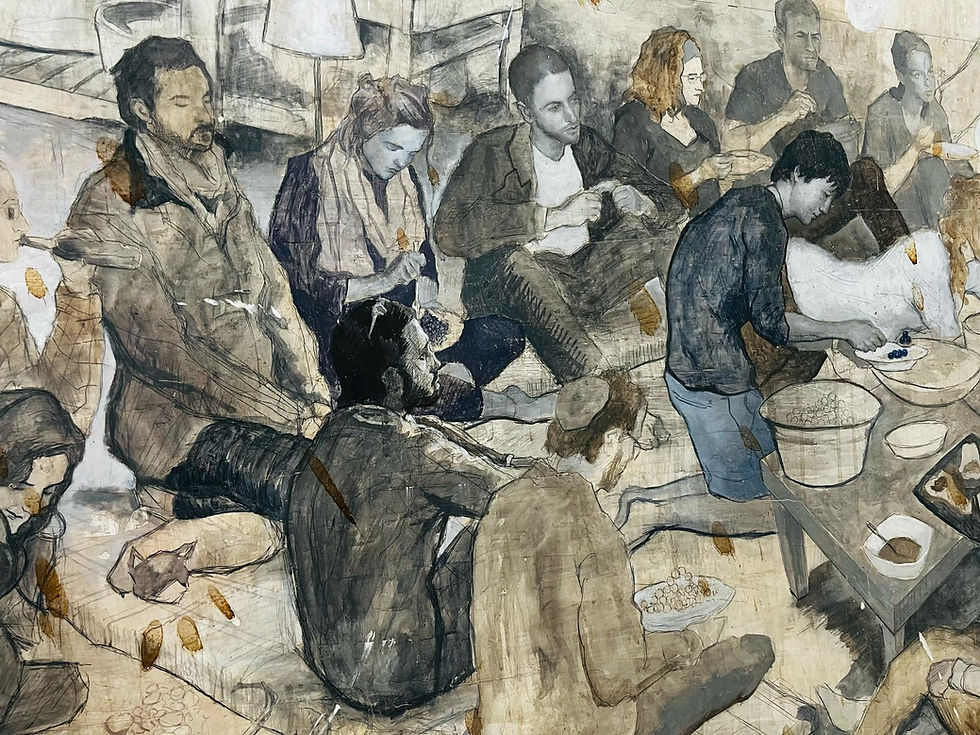


Photos and documentation from our time are scarce to protect participants. On both sides of the wall, being linked to the “other” can be seen as treason—so few faces appear in EcoME photos on this page.


